Everyone Else Seems to Be Having a Moment — And You're Just Sitting There
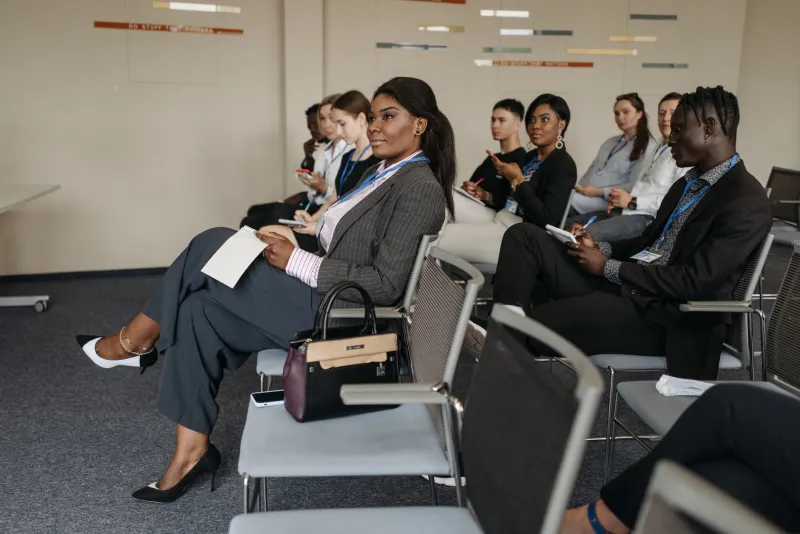
You came here to feel better about yourself. And somehow, watching the woman two rows over weep beautiful, healing tears while the facilitator nods knowingly, you feel... worse. Not because anything bad happened. But because that didn't happen to you, and you're starting to wonder what that says about where you are.
Welcome to one of the most unspoken paradoxes of body-positive spaces: the comparison trap doesn't disappear just because the subject changes from dress sizes to healing journeys. It just wears different clothes.
The Irony Nobody Talks About
Body-positive conferences, workshops, and community gatherings are built on the premise that every body — and every person inside one — belongs. The messaging is inclusive, the language is careful, the facilitators are warm. And yet, the moment you put a group of humans in a room together, the human brain does what it was literally wired to do: scan the environment, assess others, and measure itself against what it finds.
This isn't a character flaw. It's neuroscience. Our brains evolved in social groups where reading the room was a survival skill. The problem is that this ancient instinct doesn't always serve us in a circle of folding chairs where someone is sharing a breakthrough about learning to eat lunch without shame.
The result? A specific, sneaky kind of FOMO that wellness culture doesn't really have language for yet. Call it transformation envy. You're not jealous of someone's body. You're jealous of their catharsis.
Why Group Settings Amplify This
There's something about the structure of group wellness events that can accidentally set the stage for comparison. Testimonials, share-outs, visible emotional responses — these are all meaningful parts of collective healing. But they're also highly visible. When someone has a visible breakthrough, it registers. When your own experience feels quieter, flatter, or just plain confusing, the contrast can feel significant even when it isn't.
Social psychologists call this "social comparison theory" — the idea that we determine our own worth, progress, or success partly by measuring ourselves against others. In a conference room full of people on wellness journeys, that instinct gets pointed directly at the most personal possible target: your healing.
And here's the thing nobody tells you before you register: healing is not a performance. It doesn't always look like tears or epiphanies or the exact moment a facilitator asks the exact right question. Sometimes it looks like sitting in a chair and feeling kind of numb and driving home and then waking up three weeks later with a slightly different relationship to your reflection. That counts. That's real. It just doesn't photograph as well.
The Stories We Tell About Other People's Journeys
When we watch someone else have a powerful moment, we're only ever seeing a sliver of their full picture. We don't see the years of therapy that led to that room. We don't see the three conferences before this one where nothing landed. We don't see what they're going home to, what they're still working through, what they're terrified of.
We see: tears, nodding, maybe a hug.
And we build a whole narrative around it. She's further along than me. He's done the real work. They get it in a way I don't. These stories feel true, but they're almost entirely invented. You are comparing your internal experience — messy, complex, fully known to you — to someone else's external presentation, which you know almost nothing about.
That's not a fair fight. It never will be.
Practical Ways to Stay in Your Own Lane
So what do you actually do when the comparison spiral starts? A few things that genuinely help:
Name it without judgment. When you notice yourself measuring your experience against someone else's, just say it internally: I'm doing the comparison thing right now. You don't have to fix it or feel bad about it. Just noticing it interrupts the automatic pilot.
Come back to your body. Literally. What do your feet feel like on the floor right now? What's your breath doing? Body-positive spaces often include grounding practices for good reason — they work. When you're spinning out into someone else's journey, your body is the fastest way back to your own.
Reframe 'nothing happened' as data, not failure. Maybe this workshop wasn't your moment. Maybe it planted something that won't bloom for a month. Maybe it confirmed that you need a different kind of support. All of that is useful information, not evidence that you're broken.
Resist the urge to perform. Sometimes when we feel like we're not having the 'right' experience, we start performing one — nodding more, sharing more, trying to manufacture a feeling that looks like what everyone else seems to be having. That's exhausting and it disconnects you from what's actually happening for you. Your real experience, however underwhelming it seems, is the only one worth paying attention to.
Talk to someone after. Not to compare notes, but to process. A friend, a therapist, a partner who gets it. Saying out loud 'I felt kind of left out of my own healing today' has a way of loosening something.
Community Is Not Competition
Here's the bigger truth underneath all of this: other people's breakthroughs are not a finite resource. When the woman two rows over has her moment, nothing is taken from you. Her healing doesn't crowd yours out. If anything — and this is the thing body-positive community is actually built on — her willingness to be open in that room made it safer for something in you to eventually open too, even if it happens later, even if it happens quietly, even if it happens on the drive home listening to a song that suddenly makes sense.
You're allowed to celebrate someone else's progress and grieve your own pace in the same breath. You're allowed to feel moved by the room without feeling personally outpaced by it.
Your journey has its own timeline. It doesn't owe anyone a dramatic moment. It just asks that you keep showing up for it — in conference rooms, in your kitchen, in the mirror, in the ordinary Tuesday moments that don't look like healing but quietly are.
You're not behind. You're just in a different part of the same story.