Room Full of Bodies: How to Stay in Your Own Experience at Wellness Events
Let's be honest about something that doesn't come up enough in body-positive spaces: sometimes the most destabilizing place to be is a room full of people who are all supposed to be embracing themselves.
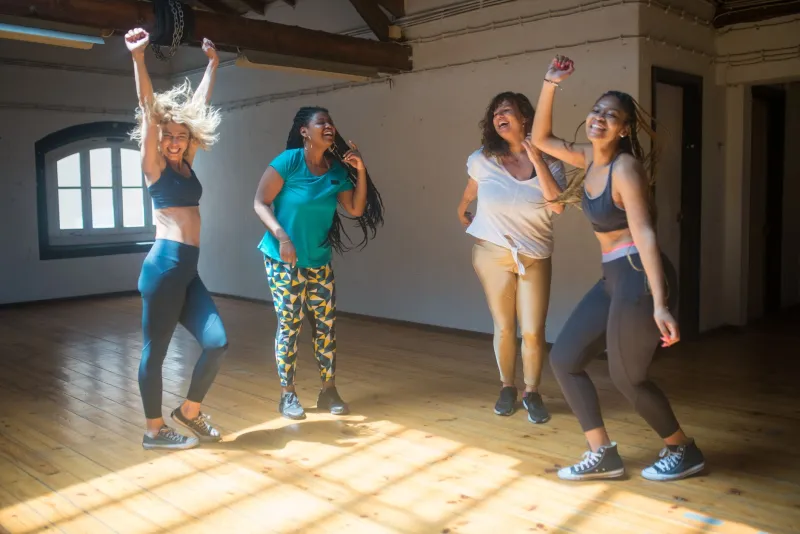
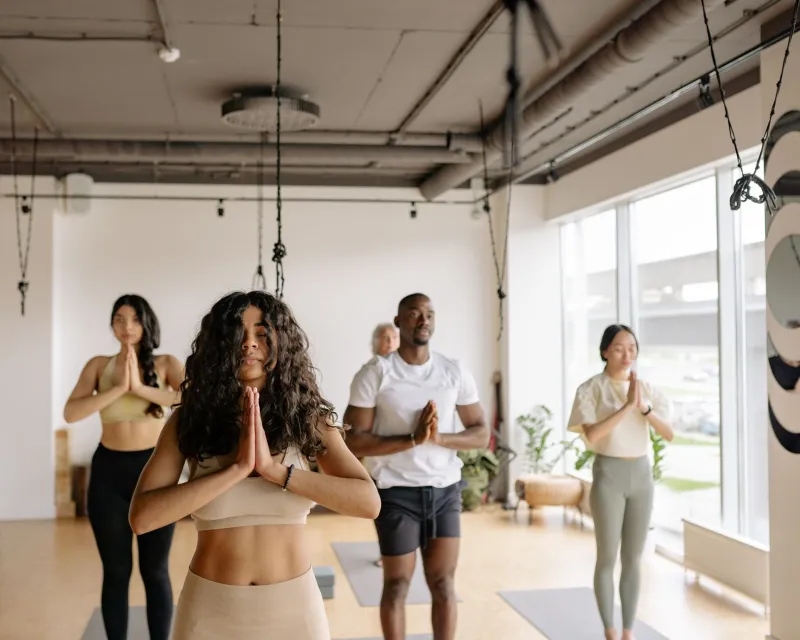
You sign up for the workshop. You show up, a little nervous, hoping it'll be different from the spin class where you spent forty-five minutes staring at your reflection and cataloging everything wrong with it. And then you walk in, and there are all these bodies — diverse, confident, moving freely — and instead of feeling liberated, you feel... smaller. More aware of yourself. More aware of how you measure up.
If that's happened to you, you're not broken. You're human. And you're experiencing one of the more uncomfortable paradoxes of the body-positive wellness space.
The Comparison Instinct Is Old — Really Old
Your brain did not invent social comparison to make you miserable. It evolved that comparison instinct as a survival tool. For early humans, understanding where you stood relative to others in your group — in terms of strength, status, desirability, capability — had real consequences for survival. The brain that tracked social hierarchy was the brain that stayed alive.
Fast-forward to now, and that same ancient wiring is firing in a yoga studio in Austin or a conference ballroom in Chicago, measuring your body against the bodies around you with the same urgency it once used to assess physical threats. The context has completely changed. The neural machinery hasn't.
Neuroscientist and social comparison researcher Dr. Sarah Hill and others in her field have documented how social comparison activates the brain's reward and threat systems simultaneously — meaning it can feel both compelling and awful at the same time. You don't want to be comparing yourself. You can't quite stop. That tension is exhausting, and it's completely normal.
Why Body-Positive Spaces Can Amplify the Effect
Here's the uncomfortable part: spaces explicitly designed to celebrate all bodies can sometimes intensify comparison rather than quiet it.
Part of this is attention. When you walk into a space where bodies are the explicit subject — where the whole point is to honor and celebrate the physical self — your brain naturally focuses on bodies, including yours and everyone else's. The very thing the space is trying to neutralize becomes the thing you can't stop noticing.
There's also an invisible hierarchy that can emerge even in the most intentionally inclusive environments. Maybe someone in the front of the room is moving with a confidence you don't feel yet. Maybe someone else seems completely at home in their skin in a way that reads as aspirational — and then, almost immediately, threatening. They're doing this right. I'm doing it wrong.
Attendees at Body Love Conference events have described this exact experience — showing up hoping to feel less alone in their body struggles, and briefly feeling more alone instead because everyone else seemed to have already arrived somewhere they were still trying to reach.
That feeling is real. It's also a lie. But knowing it's a lie doesn't automatically make it stop.
The Comparison Trap Has a Specific Shape
Social psychologist Leon Festinger's foundational research on social comparison theory identified two directions the instinct tends to run: upward comparison (measuring yourself against someone you perceive as doing better) and downward comparison (measuring against someone you perceive as doing worse). Both are traps.
Upward comparison in a wellness context sounds like: She looks so comfortable in her body. Why can't I feel that way? What's wrong with me?
Downward comparison — which can feel temporarily reassuring but is ultimately just as corrosive — sounds like: At least I'm not as [fill in the blank] as...
Both moves take you out of your own experience and into a ranking system that has nothing to do with your actual wellbeing. And both are completely automatic until you learn to catch them.
Grounding Techniques That Actually Work in the Moment
The five-senses reset. When you notice comparison pulling you out of your body and into your head, do a quick sensory inventory: What do you hear right now? What does the floor feel like under your feet? What can you smell? This isn't a distraction technique — it's a genuine neurological interrupt. Sensory grounding activates the parasympathetic nervous system and pulls attention back to present-moment physical experience, which is exactly where you want to be.
Curiosity instead of judgment. When you catch yourself evaluating another person's body or movement — or your own — try replacing the evaluation with curiosity. Not she moves so much more freely than I do but I wonder what her experience of this feels like. It sounds small. It shifts something.
The personal metric check-in. Before you enter a workshop or event space, spend two minutes identifying one thing you're personally hoping to feel or experience — not achieve, not look like, just feel. Write it on your phone if you need to. When comparison pulls you sideways, come back to that single intention. It re-centers the whole experience around you.
Acknowledge the comparison without feeding it. You don't have to pretend you're not comparing. You can notice it: Oh, there's the comparison brain doing its thing. Naming it without acting on it — without spinning into shame about the fact that you're comparing — is its own kind of practice.
Community as Witness, Not Competition
One of the things we talk about a lot at Body Love Conference is the difference between being witnessed and being evaluated. Community is supposed to function as the former. When it accidentally becomes the latter — when a room full of people celebrating their bodies becomes a silent competition about who's doing it best — something has gone sideways.
The antidote isn't to stop going to events or to close yourself off from other people's experiences. It's to keep coming back to a simple truth: other people's confidence doesn't diminish yours. Other people's ease in their bodies doesn't mean you're behind. There is no finish line here, no ranking, no one doing it right.
Every person in that room is working something out. Including the one who looks like they've already figured it all out.
You belong in that room. Not to measure yourself against the people in it — but to be held by them, and to hold them back.