Pass the Dish: Why Eating Together at Body-Positive Events Is Quietly Changing Everything
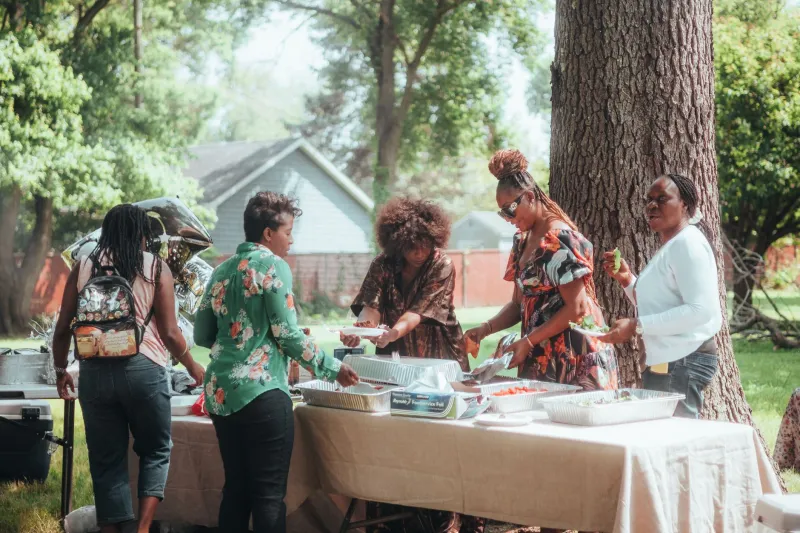
There's a moment that happens at nearly every body-positive gathering across the country. Someone sets a casserole dish down on a folding table. Someone else adds a bowl of pasta salad. A third person slides in a pan of brownies — no asterisk, no apology, no "but I used almond flour" disclaimer. And then, slowly, people start to eat. Together. Without commentary.
For a lot of attendees, that moment is more transformative than any keynote they'll sit through all weekend.
Communal eating has been a cornerstone of human connection forever — church potlucks, neighborhood block parties, Thanksgiving tables that seat thirty. But inside body-positive conferences and wellness gatherings, it's taking on a whole new dimension. It's becoming something closer to a healing practice. A political act, even.
Diet Culture Doesn't Survive a Potluck
Think about how most of us learned to eat in social settings. We learned to scan the table for the "safe" options. We learned to comment on what we were putting on our plates — to preemptively justify it, minimize it, or apologize for it. We learned that eating in front of others required a kind of performance: restraint, virtue, control.
A body-positive potluck dismantles that script almost immediately.
When event organizers intentionally frame a shared meal as a judgment-free space — no diet talk, no food moralizing, no comments about what's on anyone's plate — something shifts in the room. People eat differently. They slow down. They actually taste things. They talk to each other instead of silently calculating.
Jessica, a conference organizer based in Portland, Oregon, has been hosting body liberation events for six years. She started incorporating potluck-style meals after noticing how differently attendees behaved around food when the environment was intentional. "The first time we did it, people kept waiting for someone to say something — to make a joke about the mac and cheese or ask if anyone brought a 'lighter' option," she says. "When nobody did, you could physically see people exhale."
What Intuitive Eating Research Tells Us About Eating in Community
The intuitive eating framework — developed by dietitians Evelyn Tribole and Elyse Resch and now backed by a growing body of research — centers on reconnecting with your body's internal hunger and fullness cues rather than external rules. One of its core principles is making peace with food, which means removing the moral charge we assign to eating choices.
But here's the thing: that internal reconnection doesn't happen in a vacuum. It's shaped by the social environment around us. Studies have consistently shown that eating with others influences how much we eat, how we feel about what we eat, and even how we feel about our bodies afterward. When the social environment is critical or diet-focused, those effects tend to be negative. When it's warm, relaxed, and non-judgmental, the opposite is true.
Body-positive events are, in effect, engineering that second environment on purpose.
Registered dietitian and body image counselor Maya Thornton, who has facilitated nutrition workshops at wellness conferences in Atlanta and Chicago, puts it plainly: "Eating with people who aren't commenting on your food choices or their own is genuinely rare for most Americans. When it happens in a community setting, it can crack something open. People start to realize that the running commentary in their head isn't inevitable — it came from somewhere, and it can be unlearned."
The Dish You Brought Matters More Than You Think
There's another layer to the potluck dynamic that doesn't get talked about enough: the act of bringing food is its own form of vulnerability and generosity.
For people who've spent years treating food as the enemy, cooking something and offering it to others is a genuinely big deal. It requires trusting that the dish you made is worthy. That you are worthy of feeding people. That your grandmother's sweet potato pie or your roommate's queso recipe or the store-bought cookies you grabbed at the last minute are all equally welcome at the table.
At a body liberation conference in Austin last spring, one attendee described bringing a dish for the first time in years. She'd stopped cooking for others after years of comments about her weight — she'd internalized the idea that someone like her shouldn't be offering food. "I brought tamales," she said. "And people loved them. That sounds so small, but I cried in my car afterward. It felt like getting a part of myself back."
That's not a small thing. That's the potluck principle in action.
Creating the Conditions for Something Real
Of course, none of this happens automatically. A shared meal can just as easily reinforce diet culture if the space isn't held intentionally. Event organizers who are doing this well tend to be pretty deliberate about it.
That means setting explicit community agreements before the meal — something as simple as "no diet talk or food commentary during this gathering." It means having facilitators who gently redirect if someone starts comparing plates or making self-deprecating remarks about what they're eating. It means framing the meal in the program not as a break from the "real" content, but as part of it.
Some conferences have started incorporating brief community rituals around the meal itself — a moment of gratitude, a prompt to share one thing you're nourishing in yourself this season, or simply an invitation to sit with someone you haven't met yet. Small moves that signal: this table is different. You're safe here.
Why This Scales Beyond the Conference Room
What makes the communal eating piece so interesting is how transferable it is. You don't need a conference budget or a keynote speaker to recreate this in your own community. You need a table, some food, and an agreement to leave the calorie-counting at the door.
Body Love Conference gatherings — whether they're large-scale events or small local meetups — have always been built on the idea that transformation happens in community. Not just in workshops or panel discussions, but in the in-between moments. The conversations over coffee. The walks between sessions. The meals.
And maybe especially the meals.
Because something about sitting down together, passing a dish across the table, and eating without apology or explanation is just deeply, stubbornly human. It's the thing we've always done to say you belong here. In a culture that's spent decades making people feel like their bodies are problems to be solved, that message — delivered through a shared plate of food — lands somewhere words often can't reach.
So yeah. The potluck is radical. Pass it on.