Face to Face With Yourself: The Uncomfortable Magic of Mirror Work at Body-Positive Events
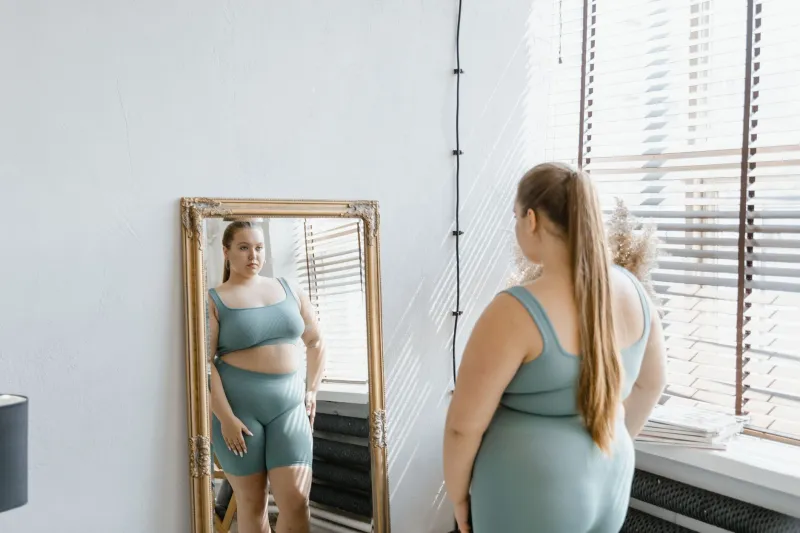
There's a moment that happens at a lot of body love gatherings — usually mid-morning, after the opening circle but before anyone's had enough coffee to feel fully armored — when a facilitator rolls a full-length mirror to the center of the room and says something like, "Take your time. Just look."
And the room gets very, very quiet.
For some people, it's the first time in years they've looked at themselves without immediately reaching for a criticism. For others, the discomfort is so immediate it feels physical — a tightening in the chest, a sudden interest in their shoes. A few cry before they even fully process why.
This is mirror work. And at body-positive conferences and wellness gatherings across the country, it's becoming one of the most talked-about — and quietly transformative — practices in the self-acceptance space.
What Mirror Work Actually Looks Like in Practice
The term "mirror work" was popularized decades ago by self-help author Louise Hay, but the version showing up at today's body love events is something more nuanced and community-centered than the solo affirmations-in-the-bathroom approach most people picture.
At structured body-positive workshops, mirror exercises are facilitated experiences — meaning there's a trained guide in the room, there are other participants nearby, and there's an intentional framework designed to hold space for whatever comes up. Participants might be asked to look at one part of their body and name something neutral about it (not positive, not negative — just factual). They might be guided through a slow, deliberate visual scan while a facilitator reads a grounding script. In some workshops, pairs sit across from each other and describe what they see in their partner's face while the partner practices receiving that witnessing without deflecting.
It sounds simple. It rarely feels that way.
"People come in thinking it's going to be a feel-good exercise," says one workshop facilitator who runs body image intensives in the Pacific Northwest. "And then they realize it's more like... excavation. You're digging up stuff you've been burying for a long time."
Why the Discomfort Is the Whole Point
Here's the thing that often surprises first-timers: facilitators aren't trying to make mirror work comfortable. They're trying to make it survivable — and then transformative.
The psychology behind this approach draws on exposure therapy principles and somatic awareness practices. Avoidance, it turns out, is one of the key mechanisms that keeps negative body image locked in place. The less we look at ourselves — really look, without immediately turning away or criticizing — the more power the fear grows. The mirror becomes a site of dread rather than neutral information.
Dr. Renee Engeln, a body image researcher and author of Beauty Sick, has written extensively about how the cultural habit of "body monitoring" — constantly checking and critiquing our appearance — is different from genuine self-observation. Mirror work done well tries to interrupt the monitoring loop and replace it with something closer to witnessing: the practice of seeing without immediately judging.
In a group setting, that shift becomes possible in a way it often isn't alone at home. "When you're surrounded by other people doing the same vulnerable thing, your nervous system gets a different signal," explains a somatic practitioner who facilitates workshops at body-positive conferences on the East Coast. "The shame response starts to soften because your brain is registering: I'm not alone in this. Other people are here. I'm safe."
Real Participants, Real Reactions
Ask anyone who's been through a structured mirror exercise at a body love event and you'll get answers that run the emotional spectrum.
Marisa, 34, from Atlanta, attended a weekend body-positive retreat last spring and described her experience during a partner witnessing exercise as "the most uncomfortable twenty minutes of my adult life, followed by something I can only describe as relief." She'd spent most of her thirties avoiding mirrors beyond a quick hair-check. Being asked to sit still and be seen — by herself and by another person — surfaced grief she hadn't expected. "I realized I'd been treating my body like it was something to apologize for," she said. "And having someone else just... look at me kindly, without flinching, broke something open."
Not everyone finds the experience immediately cathartic. Deja, 27, from Chicago, said her first mirror workshop left her feeling raw and unsettled for days afterward. "I didn't cry in the room. I cried in my car for forty-five minutes on the way home." She went back to a follow-up session three months later and described the second experience as completely different — gentler, somehow, even though the exercise was the same. "I think I needed time to process what came up the first time before I could actually receive the second round."
This is why skilled facilitators emphasize that mirror work isn't a one-and-done fix. It's a practice — something that builds over time, ideally in community.
Community Is the Ingredient That Changes Everything
Here's what distinguishes the mirror work happening at body-positive conferences from the kind of solo self-help practice most of us have attempted and quietly abandoned: other people.
Shame, as researcher Brené Brown has famously argued, cannot survive being witnessed with empathy. The reason so many of us struggle to make peace with our bodies in isolation isn't a lack of willpower or the wrong affirmations — it's that we're trying to heal a wound that is, at its core, relational. Bodies are experienced in relation to other bodies, to cultural messages, to how we've been seen or unseen throughout our lives. It makes a certain kind of sense that healing might need to happen in relation, too.
When a room full of people — different ages, sizes, skin tones, abilities, gender expressions — all practice looking at themselves and each other with something approaching kindness, something shifts in the collective field. Participants frequently describe a sense of permission they couldn't manufacture on their own. Seeing someone else look in the mirror and not collapse, not immediately reach for a put-down, creates new evidence for what's possible.
"It's like your nervous system takes notes," one facilitator put it. "And those notes follow you home."
What to Expect If You're Considering It
If you're curious about mirror work but the idea makes you want to close this tab immediately — that reaction is actually pretty useful information. It usually means there's something worth exploring.
A few things worth knowing before you walk into a workshop:
You won't be forced to do anything. Reputable facilitators build in options and exits. Participation is always a choice, and good practitioners make that explicit.
Discomfort doesn't equal harm. There's a difference between the productive discomfort of doing something vulnerable and the kind of distress that signals you need additional support. If you have a trauma history related to your body, it's worth connecting with a therapist alongside any workshop experience.
The goal isn't to love what you see. At least not right away. The goal is to be able to look — to stay present with yourself long enough to gather real information instead of the running commentary your inner critic has on autoplay.
Community matters more than the mirror itself. Who's in the room with you, and how that space is held, will shape everything about the experience.
The mirror, in the end, is just a tool. What makes these moments meaningful — what makes them stick — is the gathering of people willing to do the uncomfortable, necessary work of being seen. Together.
And that's exactly what body love is built for.